Tell Us What You Need →
Home›Produce›Vegetables›Potatoes

Egyptian Potatoes

One of Egypt’s leading fresh-produce export crops.

Egyptian potatoes are a cornerstone of the country’s agricultural export sector and are supplied to a wide range of international markets.

Commercial sourcing Season-led programmes Local supplier network Buyer-led specification
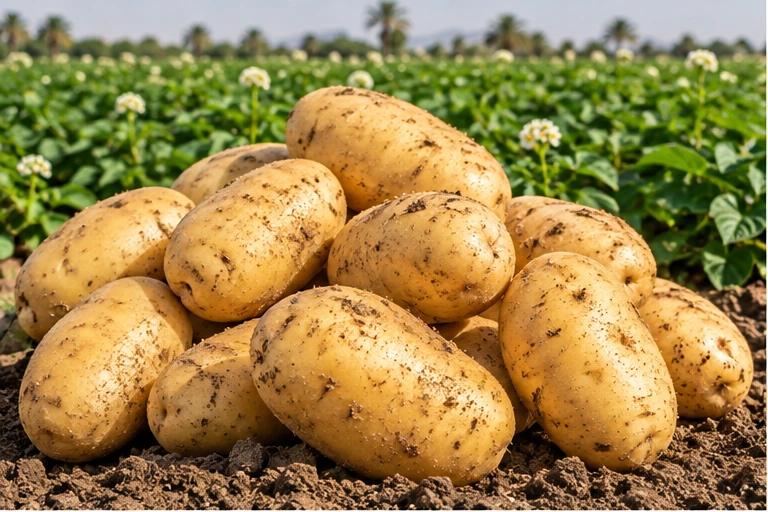
Fresh Egyptian Potatoes

Typical Egyptian Season

Jan
Feb
Mar
Apr
May
Jun
Jul
Aug
Sep
Oct
Nov
Dec
Typical availabilityOutside main window

Indicative availability: December – June. Harvest and export windows can move slightly according to crop year, growing region, variety, buyer specification and destination market.

About Egyptian Potatoes

Potato sourcing is specification-heavy. Variety, intended use, skin finish, size, dry matter, washing requirements, sprouting condition, residue standards, certification and destination rules can all affect suitability.

Rather than treating potatoes as a generic commodity, Midori Agriculture works from the intended market and use case to identify more appropriate supply.

  • Major Egyptian export crop
  • Multiple varieties and end uses
  • Fresh, wholesale, foodservice and processing relevance
  • Specification and destination requirements are central
OriginEgypt; exact growing region varies by crop, variety and current programme.
Commercial basisAssessed against specification, volume, destination, compliance and timing.
Typical seasonDecember – June, subject to crop-year confirmation.
Egyptian agricultural production landscape

Egyptian Produce Sourcing

Commercial guide to Egyptian Potatoes

Useful context for importers, wholesalers, distributors, retailers, foodservice buyers and other organisations assessing potatoes from Egypt.

Commercial context

Egyptian potatoes are one of the country’s major agricultural export crops and are traded into a wide range of international markets. The sector serves fresh consumption, packing, foodservice and processing requirements, with different varieties selected according to end use. A potato suitable for retail washing and packing may not be the best choice for chips, fries or industrial processing. Variety, dry matter, skin finish, size distribution and storage history therefore matter as much as headline tonnage when a buyer is planning a reliable commercial programme.

What buyers should define

A potato brief should normally define variety or end-use characteristics, size range, skin finish, washing or unwashed presentation, defect tolerances, sprouting expectations, pack format and any destination-specific phytosanitary requirements. Processing buyers may also focus on dry matter, reducing sugars, fry colour and solids. Fresh retail customers may prioritise appearance and uniformity. Soil type, harvest timing and storage can all affect final quality, so buyers should specify the intended use clearly rather than relying on a generic “export potato” description.

Season and programme planning

Egyptian potato production is organised across multiple planting and harvest periods, giving the country a significant export window. Major production areas include the Delta and reclaimed agricultural zones, with programmes timed around destination-market access and crop maturity. Early, mid and stored potatoes can present different skin set and quality characteristics. Buyers planning recurring shipments should therefore discuss which crop cycle is being offered and whether later-season supply will come fresh from harvest or from controlled storage.

How Midori Agriculture can support

Midori Agriculture can support potato sourcing by matching the buyer’s end use with suppliers able to offer appropriate varieties, grading and packing. We can help clarify whether a quotation is genuinely comparable in terms of size, condition, crop cycle and presentation, and support local follow-up on programme timing and documentation. For larger or recurring requirements, our role can extend to keeping communication moving between buyer, supplier and other parties involved in the shipment so that commercial expectations remain aligned.

Quality & Specification

Commercial fresh produce is specification-led. We start with the buyer’s market and intended use, then assess suppliers against the characteristics that matter for that programme.

  • Variety, type, maturity and intended use
  • Grade, sizing, appearance and defect tolerances
  • Residue, traceability and destination-market requirements
  • Certification and audit requirements where needed
  • Packing, labelling, palletisation and private-label requirements
  • Arrival condition, shelf-life expectations and delivery programme

Sourcing Through Midori Agriculture

We can assess potato programmes by variety, use, size, presentation, packing, timing, destination and compliance requirements.

We translate the commercial requirement into a clear sourcing brief, identify relevant Egyptian supply options and help coordinate discussions, samples, specifications, commercial terms and follow-up.

  • Requirement-led supplier identification
  • Local communication and commercial follow-up
  • Specification and packing coordination
  • Support for trial, seasonal and recurring programmes

Looking for Egyptian Potatoes?

Tell us your quantity, destination, timing and specification and we’ll assess suitable sourcing routes.

Enquire Now →

Who We Supply

Importers, potato specialists, wholesalers, foodservice distributors, processors and retail supply chains.

Export & Logistics Support

Depending on the engagement, support can include packhouse liaison, specification communication, documentation coordination, shipment planning and delivery follow-up.

Quality & Compliance

Supplier selection can take account of quality, traceability, certification and destination-market requirements. Capabilities are confirmed for the specific supplier and programme.

Commercial Buyer Guide

What to consider when sourcing Potatoes

Practical points to help commercial buyers define a stronger brief before quotations and supplier discussions begin.

Commercial fit

Potatoes are one of the major Egyptian export crops, but commercial suitability depends heavily on variety and end use. A table-potato buyer, processor and foodservice supplier can have very different expectations for dry matter, shape, skin finish and size distribution.

Specification focus

The brief should identify variety where required, size range, skin and flesh type, washing or brushing preference, sprouting tolerance, permitted mechanical damage, pack format and intended end use. Processing customers may also have technical characteristics that should be supplied as a written specification.

Handling & arrival quality

Curing, storage, grading and loading practices influence skin condition and arrival quality. Temperature should be managed according to variety, storage history and end use, and the buyer should understand whether the product is being supplied directly from harvest or from storage.

Programme planning

For larger programmes, it is useful to agree the expected size profile and volume over time because crop grading naturally produces multiple sizes. A realistic programme can create better continuity than repeatedly requesting only a narrow portion of the crop.

Buying Potatoes from Egypt

Potatoes from Egypt can form part of seasonal or programmed fresh-produce supply for importers, wholesalers, distributors and other commercial buyers. Midori Agriculture supports enquiries by combining the buyer’s requirement with local market knowledge, supplier relationships and practical coordination in Egypt.

Fresh potatoes are one of Egypt’s most important agricultural export lines and are supplied into a range of international wholesale, retail and processing markets. The commercial opportunity is broad, but potato sourcing is highly dependent on variety, intended use, tuber size, skin finish and destination-market plant-health requirements.

Buyers should state whether the potatoes are for fresh retail, wholesale, chipping, processing or another use, as this affects variety and dry-matter expectations. Specifications may include size range, shape, skin set, soil level, greening, sprouting, mechanical damage, scab tolerance and packing. For some destinations, production areas and phytosanitary status can also be particularly important.

Midori Agriculture can help buyers define a workable Egyptian potato brief and assess suppliers with the relevant crop, grading and packing capability. For recurring programmes, size distribution and available volume should be discussed against the crop rather than assumed from a single sample.

Midori Agriculture does not treat produce as a fixed retail catalogue. Availability, grade, variety, packing capability and commercial terms are assessed against the buyer’s live requirement and current crop conditions.

Planning around the Egyptian season

The month-by-month calendar is a planning guide rather than a contractual promise. Harvest and export windows move with weather, growing region, variety, crop development, storage capability, market access and destination specifications. Current availability is reconfirmed before commercial commitment.

Frequently asked questions

Can you assess a one-off shipment?

Yes. Trial, one-off and recurring requirements can be assessed where volume, destination and specification are commercially viable.

Can you work to an existing specification?

Yes. Upload a specification, tender or product sheet with the enquiry so grade, packing, certification and destination requirements can be incorporated from the outset.

Do you only source products listed here?

No. The catalogue focuses on important Egyptian crops. Other agricultural requirements can also be submitted for assessment.

Are the seasonal months guaranteed?

No. They are indicative planning windows and are reconfirmed for the crop year, supplier, destination and requested programme.