
Sweet Potatoes
Egyptian Sweet Potatoes: A Commercial Buyer’s Guide
Egyptian sweet potatoes have become an increasingly visible export line. Strong programmes depend on variety, curing, shape, skin condition, size profile and storage as much as on headline availability.
Last reviewed: 14 October 2026. Commercial and regulatory information should be checked against current requirements before shipment.
Confirm variety and flesh colour
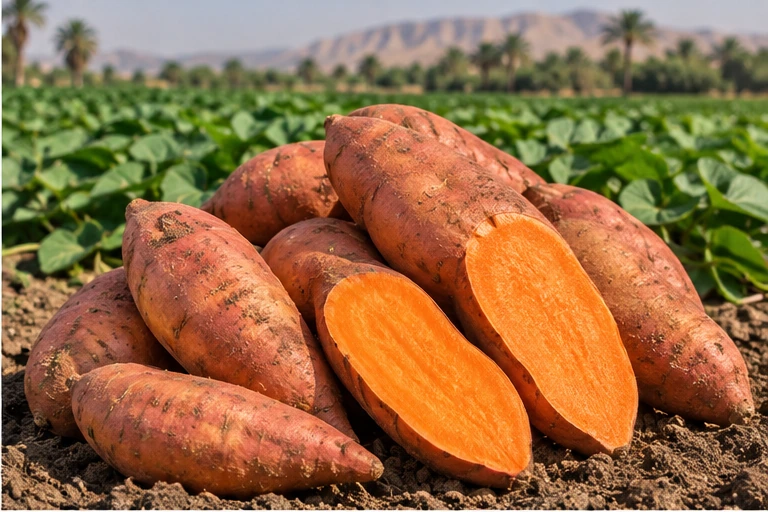
Orange-fleshed varieties dominate many export programmes, but the buyer should still confirm the required variety or eating profile. Skin colour alone is not enough to define the product.
Curing affects commercial performance
Appropriate curing helps wounds heal and supports storage performance. Ask how the crop is handled after harvest and how long it has been stored before packing.
Shape and size matter to retail yield
Long, twisted or irregular roots may be perfectly edible but unsuitable for premium retail packs. Define the acceptable shape and weight or diameter range for the intended customer.
Protect the skin
Sweet-potato skins can mark easily. Harvesting, washing, handling and packing methods influence cosmetic quality and later deterioration.
Build seasonal expectations into the programme
As a season progresses, skin condition, storage characteristics and available sizes can change. A recurring specification should distinguish between essential requirements and reasonable seasonal tolerances.
Use trials intelligently
A trial shipment can test not only the product but also curing, packing, communication and arrival condition. Review all four before scaling volume.
The export window is shaped by harvest and storage
The main Egyptian sweet-potato harvest is concentrated in the second half of the year, while curing and storage can extend commercial supply. USDA reporting has highlighted a strong Egyptian export period from roughly August into January, with the exact window moving by crop and market. Buyers should distinguish between freshly harvested product and roots that have been held in storage for a longer period.
That distinction matters because skin condition, moisture loss, sprouting and eating quality can change over time. A supplier should be able to explain the crop date and post-harvest handling behind the offer.
Retail programmes need a realistic shape tolerance
Sweet potatoes naturally vary in length, curvature and taper. Very tight cosmetic specifications can generate low pack-out yield and make weekly continuity difficult. Buyers should identify which defects genuinely affect the consumer proposition and which natural variations are commercially acceptable.
Clear photographic standards are often more useful than ambiguous terms such as “perfect shape”. They help packhouse teams understand the intended retail presentation and reduce disagreements after arrival.
Temperature management is different from ordinary potatoes
Sweet potatoes are sensitive to chilling and should not be handled as if they were standard ware potatoes. The correct storage and transport regime depends on the variety, curing history and journey. Buyers and logistics providers should agree the temperature strategy with the supplier rather than applying a generic vegetable setting.
This is especially important for longer sea-freight routes, where a small error in temperature can create quality problems that only become visible after arrival.
Explore Egyptian sweet potatoes
Send us the commercial details and we will assess how Midori Agriculture can help.